January 16
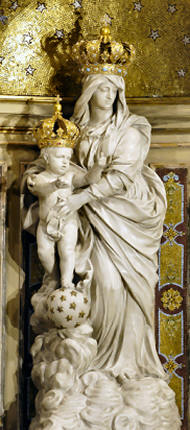
Notre-Dame des Victoires, Refuge des Pécheurs, Paris, France
In thanks for his successful siege of the Huguenot city of La Rochelle, which surrendered in 1628, King Louis XIII gave the Barefoot Augustinians funds to build a new monastery in Paris, with a chapel dedicated to Our Lady of Victories. A statue of the Virgin with crown and scepter, carved from the miraculous oak of Montaigu, was placed in the chapel.
In 1674, Brother Fiacre returned to the monastery from Italy full of enthusiasm for Our Lady of Mercy of Savona, to whom he had a chapel built under the title Refuge of Sinners. That title—which goes back to at least the 1500s, when Refugium peccatorum was included in the Litany of Loreto—was added to Our Lady of Victory in the church's name, and January 16, feast of Our Lady, Refuge of Sinners, became the sanctuary's patronal feast. Both statues were lost during the Revolution, when the monks were expelled and the church closed. A new statue of Our Lady of Victories (left) was installed when the church reopened under diocesan clergy in 1809.
Still, the parish was struggling until December 3, 1836 when, while saying a mass attended by 40 people, pastor Charles Desgenettes heard Our Lady's voice asking him to consecrate the church to her immaculate heart. He did so that day, and mass attendance shot to 500. He then founded a confraternity dedicated to Our Lady, Refuge of Sinners, which attracted a large membership. Pilgrims began flocking to the church and reporting miracles, covering the walls with ex votos. In 1853, Pope Pius IX had the statue crowned. In 1883, St. Thérèse of Lisieux recovered from a persistent illness during a series of masses there on her behalf.
Source: Basilique de Notre-Dame des Victoires, www.notredamedesvictoires.com (image © Esprit-Photo.com)
Also celebrated this date:
|
