Second Saturday in May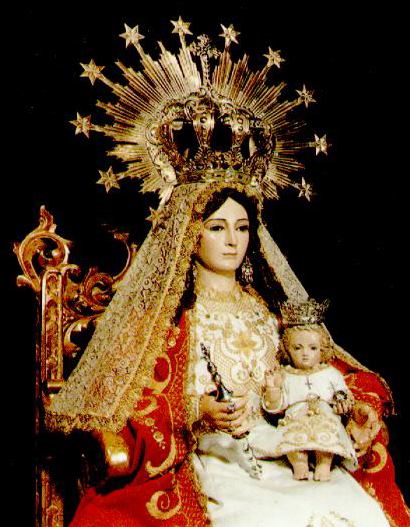
Virgen de España, Calañas, Huelva, Andalucía, Spain
The story goes that in 1340, Juan Batista Tagarete of Beas in southern Spain went hunting in the mountains with his son Juan. Some 16 miles northwest of town, along the Río Odiel, they came upon statues of Christ and his Mother hidden in a briar patch, along with a document relating the history of the image of the Virgin: in the year 390, a chapel to St. Mary was built near the iron mines in those mountains. The king of Spain sent it a statue of the Virgin and Child, modeled by a court artist after the Queen and her son, hence the name Our Lady of Spain. Another local tradition maintains that after the Muslim victory at the Battle of Guadalete in 711, the last Visigothic king, Rodrigo, fled there and took shelter in the Chapel of Spain, where he died and was buried.
Destroyed in a fire in 1734, the statues had been replaced by 1793. Revolutionaries burned the second Virgin in 1936. In 1956, Sevillian sculptor Antonio Castillo Lastrucci made a new statue of the Virgin of Spain. Like that of the 1700s, it is a candelero image, about two feet high, with carved face, hands, and child on a dressed stand.
Every year on the second weekend in May, Catholics from Beas make a three-day pilgrimage to the Chapel of the Virgin of Spain. On Friday afternoon they escort their processional cart north along the train tracks to the pastureland of Pallares, where they build bonfires and camp for the night. Around noon on Saturday they reach the chapel in the Sotiel Coronado district of Calañas. As evening falls, they say the rosary and hold a procession with the statue of the Virgin, celebrating into the night. On Sunday, after mass and lunch, the group returns to Beas. Every five years they bring the Virgin of Spain home with them, to stay for a year.
Although this romería has persisted for centuries, it is not the biggest religious event in either Beas or Calañas. On August 15 Beas honors its patron, the Virgen de Clarines, whose statue was also found in the 1300s, but within the town in the Clarines neighborhood. Calañas, about five miles northwest of the chapel of Our Lady of Spain, honors its patron, the Virgen de la Coronada, on the Sunday after Easter. Her statue, said to have been carved in 790, was found in 1540, and her chapel built in Sotiel opposite the Virgin of Spain's.
Sources:
 | Cristóbal LLanes Baquero, "La Ermita e Imagen de Ntra.Sra. de la Coronada (Sotiel)," webcristobal.iespana.es/UNIFORMIDAD.HTM |
| Beas, www.aytobeas.es/21011/paginas/html/default.htm |
| "Lugares de interés," Ayuntamiento de Calañas, www.calanas.org/index.php?id=1628 |
| "Romería de La Virgen de España - Beas - Huelva," Las Romerías, www.lasromerias.com/pages/andalucia/beas/beas.htm (picture) |
Also commemorated this date:
| Madonna della Perseveranza, Rome, Italy, Pontificio Seminario Romano Minore. Seminary's patronal festa, solemn mass. |
| Madonna della Pace, Sora, Frosinone, Latium, Italy, Le Compre district. Mass, procession, music. |
| Santissima Maria della Stella, Armento, Potenza, Basilicata, Italy (St. Mary of the Star). Festa and procession to sanctuary. |
| Onze Lieve Vrouw van Rust, Heppeneert, Maaseik, Limburg, Belgium (Our Lady of Peace). Pilgrimage from Roermond, Netherlands. |
| St. Mary, Haddington, East Lothian, Scotland. Church of Scotland. Annual ecumenical pilgrimage. |