marian anniversaries august
Second Sunday after August 15
Onze-Lieve-Vrouw ten Traan, Kalfort, Puurs, Antwerp, Flanders, Belgium
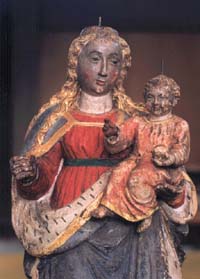 As early as the 1200s there was a monastery dedicated to
Our Lady by the Molenbeek River near Kalfort Chapel, then famous for its
relic of Christ's tears. A dual foundation of men and women, the monastery
ran a hostel for pilgrims. By the mid-1500s, the monks were gone and only
four nuns remained, so in 1552, a group of Augustinian nuns from Heindonk
settled there. Late in the century, the relic of Christ's tears was lost
when fire destroyed the chapel. But pilgrims continued to come to the
thatched replacement chapel, where by 1600 the focus of devotion had
become a statue of Our Lady on the altar. In 1640, the chapel was rebuilt
and a brotherhood of Our Lady of Tears established. After some spectacular
healings in the late 1600s, Our Lady of Kalfort was especially invoked for
eye trouble. Miracles were recorded well into the 1700s.
As early as the 1200s there was a monastery dedicated to
Our Lady by the Molenbeek River near Kalfort Chapel, then famous for its
relic of Christ's tears. A dual foundation of men and women, the monastery
ran a hostel for pilgrims. By the mid-1500s, the monks were gone and only
four nuns remained, so in 1552, a group of Augustinian nuns from Heindonk
settled there. Late in the century, the relic of Christ's tears was lost
when fire destroyed the chapel. But pilgrims continued to come to the
thatched replacement chapel, where by 1600 the focus of devotion had
become a statue of Our Lady on the altar. In 1640, the chapel was rebuilt
and a brotherhood of Our Lady of Tears established. After some spectacular
healings in the late 1600s, Our Lady of Kalfort was especially invoked for
eye trouble. Miracles were recorded well into the 1700s.
Our Lady of Tears is not a Sorrowful Mother or Pietà. Her name evidently reflects the previous cult of the Holy Tears at Kalfort. Legend relates that the statue washed up from the Molenbeek, but since it appears to date from around 1500 and is undocumented until after the arrival of the Augustinians, historians speculate that the sisters brought it with them from Heindonk. The lindenwood statue depicts Mary standing, holding a happy Child who blesses the viewer with one hand while holding an orb in the other. Since the 1700s, the statue is often displayed in rich robes, with a scepter and crown. The annual procession, originally held in July, has been held on the second Sunday after August 15, feast of the Assumption, since the shrine became a parish church in 1857.
Sources:
 | "De verering van Onze-Lieve-Vrouw ten Traan," Kalfort virtueel, www.kalfort.be/geschiedenis/klok29.htm |
| "OLV ten Traan Kalfort," bedevaartplaatsen in Belgie, www.bedevaartweb.com |
Also commemorated this date:
| Discovery of the Belt of the Holy Mother of God, Armenian Church |