Fourth Saturday in October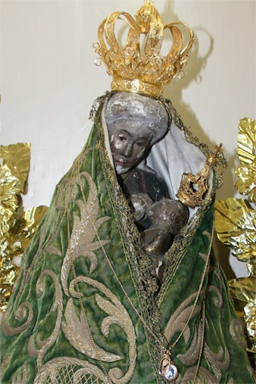
Nossa Senhora de Nazaré, Parauapebas, Pará, Brazil
Portuguese devotion to Our Lady of Nazareth began with a Black Madonna statuette (left), held to have been sculpted by St. Joseph, painted by St. Luke, and brought from Nazareth to Spain in the 400s by a monk named Ciriaco. The story goes that the image resided there in Cauliniana Monastery until 711, when the Moors conquered the area, and another monk, Rodrigo, fled with the last Visigothic king and the Black Madonna to the Portuguese coast, where they lived as hermits, enshrining the statue in a grotto. In 1182, a local leader, Fuas Roupinho, was hunting in the area when his horse lunged for a seacliff in the fog, but stopped short when he invoked the Madonna of the grotto there. Dom Fuas had a chapel built for the Madonna above the grotto, where workmen found a parchment detailing the statue's history. The town of Nazaré grew up around the shrine. Nossa Senhora de Nazaré became one of the most popular devotions in Portugal, where her feast on September 8 was celebrated with a great Círio in which participants carried a huge candle and a processional statue of the Virgin and Child over a miles-long route. Although the original statue depicted Mary seated to nurse Jesus, the processional statue depicted her standing. It was this version that traveled to Brazil with Portuguese settlers. (Picture of original Portuguese statue from commons.wikimedia.org.)
 In 1630, attracted by a mysterious light, a
fisherman checking nets found a statue of the Virgin and Child along the
seacliff near Saquarema, on Brazil's southern coast. This became the site
of Brazil's first shrine and círio to Our Lady of Nazareth. Its largest,
though, is in Belém, in the northern state of Pará. The devotion there
began in 1700, when a mestizo named Plácido found a a statuette in a
creekbed. He set it on an altar in his home, but when it repeatedly
returned to the creek, he built a shrine for it there. When the provincial
governor took the 11" image to the palace chapel, it returned to
Plácido's shrine. Now the great Basilica there hosts millions of pilgrims
at its círio on the second Sunday in October.
In 1630, attracted by a mysterious light, a
fisherman checking nets found a statue of the Virgin and Child along the
seacliff near Saquarema, on Brazil's southern coast. This became the site
of Brazil's first shrine and círio to Our Lady of Nazareth. Its largest,
though, is in Belém, in the northern state of Pará. The devotion there
began in 1700, when a mestizo named Plácido found a a statuette in a
creekbed. He set it on an altar in his home, but when it repeatedly
returned to the creek, he built a shrine for it there. When the provincial
governor took the 11" image to the palace chapel, it returned to
Plácido's shrine. Now the great Basilica there hosts millions of pilgrims
at its círio on the second Sunday in October.
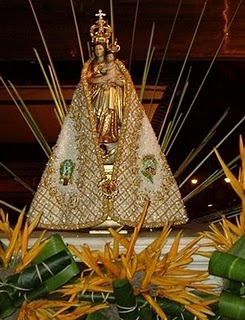
In 2005, businesswoman Edissonina Neves Alves started a círio in the town of Parauapebas, 333 miles south of Belém. Surrounding communities hold processions in the Virgin's honor for a week or two in advance. On the fourth Saturday in October, a night procession takes the statue of Our Lady of Nazareth (right) through the streets of Parauapebas, past homes and businesses with altars on display, to St. Sebastian's Church for an outdoor mass. A secular festa complements the devotions with art, theater, dance, and music. (Picture from "24/10/10 - 31/10/10," ESPAÇO ABERTO PEBAS, espacoabertopebas.blogspot.com/2010_10_24_archive.html.)